Extending the Traffic Light Problem

Of course, I looked at a simplified version of the first part of the problem. There are always more traffic lights in real life. Here's the big picture (and the real problem):

Now that you know the big picture - does my original argument still hold? To see whether it does, let us consider what happens when we choose to cross at the first traffic light if it is green.

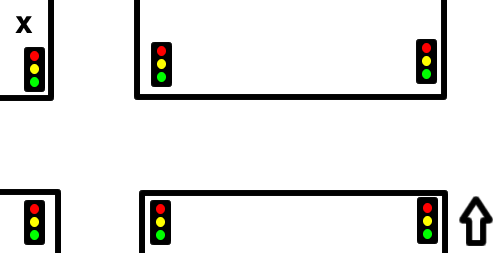
If we do, our problem is simplified to this:

Using our original assumptions of independent Bernoulli trials, you can see simply that you have a 87.5% chance of being able to cross at one of these set of the moment you come to one. This are significantly better odds than you had before (50%) - but it is still unable to beat the result from skipping that first green traffic light (100%). (Yes, crossing at that north T junction vertically DOES NOT require you to wait for a traffic light.)

Surely, there must be a point to me writing about this. The point is simple:

Minimize the number of traffic lights you have to cross to minimize travel time.

Why is this important? It will help you understand some decisions you can choose to make during my journey to university when I get to that - and the path I chose to minimize travel time, while minimizing disutility while travelling to university. Next up: why you might decide against lower travel time.

The Law of Coin Pressure

I remember have this strange theory that is usually true. I might have even mentioned it on this blog before maybe even blogged about, but this is a post entirely devoted to this funny subject.

In a contracted form, it simply says this: The more coins or small change you have, the more likely you are to give them out - and the less likely you are to receive them. I call it "coin pressure" as a reference to air pressure. Air flows from high pressure areas to low pressure areas - and so do coins. This is typically the case when you go out with friends.

Imagine the case where you go out with friends to eat. Being students, going Dutch is standard practice. There is no arguing over who pays the bill. Everyone pays the bill. Now, some places do cater to students and allow you to pay separately for items on the bill. This means that there is conversation going: "You owe this much from that, and you're supposed to pay for that, and I'm supposed to pay for this."

Usually you relegate this calculation to the accounting major students by just using the excuse that usually goes: "Let's give this to the accounting majors to sort out." In real life, there's probably a better mental mathematician at the table than the accountants (in fact I think in our case it was a management major student) - but hey, anything to not do the work. :P

After it gets sorted out, then everybody gets the numbers. Sometimes the numbers can get pretty bad change wise, for example, $8.90 per person. That means to pay exactly, you need one $5 note, one $2 coin, one $1 coin, one 50c coin, and two 20c coin - and that's already the simplest possible. 6 pieces of change to pay off your bill.

Of course, if you have the change, you just pay your part. If you don't, you take on more and more change - in general, the bigger the currency note you have to pay with, the more change you will have to carry when you leave. It follows that the opposite holds true, the more small change you have, the less small change you will have to carry when you leave. (Hence, the origin of the law.)

There is the largest possible denomination of currency - a credit card. If you are paying the bill on behalf of the table by credit card, then you effectively collect all the payment by everyone else - since you had the lowest "coin pressure".

Of course, there is such a thing as too much coin pressure. If you carry around 200 5c coins just so that you will always have enough coin pressure to pay off any possible bill within $10 - nobody will want to have to split a bill with you. :P

Moral of the story?

Carry a good variety of coins and small notes with you.

Try to never leave any coins at home unless it's in your piggy bank. Coins at home have this bad habit of accumulating to ridiculous numbers since you leave more and more and home - and leaving coins at home reduces your coin pressure, hence increasing the probability of you receiving even more coins.

Dead Time

I've gone back to having a lot of dead time - and I just realised - lazing around is pretty fun for me, even when I'm restless. Utility from doing nothing. WTF.

Cost of Gaming: Nintendo Wii and Some Reflections

This post continues from Cost: Console Gaming vs PC Gaming. I won't be assuming too much this time around since if you really want to, you can just go read the older post. The most notable is that I've made accessories into an annual cost. There are a lot of accessories for the Nintendo Wii - the Wii Fit, the Wii Wheel, the Wii Zapper, Rock Band controllers, Dance Mat and so on. A Nintendo Wii owner is more likely to buy these things than any other gamer since they are casual gamers after all. They still buy the same number of games - because I think they're idiots. (And since I own a Wii, yes I'm an idiot.)

Nintendo Wii cost: USD250

Annual cost: Accessories (random pieces of plastic, Rock Band): about USD100 a year Games: USD420

I'm gonna assume it lasts six years, even though analysts say that's unlikely (we all know how good analysts at predicting things, for an example, see predictions of Australian dollar rise about 1.6 months ago). At a discount rate of 7% p.a., Wii gaming costs: US$2624.04.

It looks like the result is similar to the XBox 360. Here's the set of numbers again to refresh your memory:

XBox 360: $2635.94 PS3: $2447.61 PC: $2313.58 PC (with MMO): $2885.57 Wii: US$2624.04

It just shows what I've already shown earlier - any addition to the annual cost is a big hit to the cost of gaming on the console. And there it is - a comparable Wii number.

Remember to take all of these numbers with a grain of salt. In essence, they assume you spend money on the same amount of games. In real life, we know that's probably not true. For example, I play significantly less Wii and PC games than I do on my XBox 360 and PS3. I've also ignored the second hand market. If you play your cards right, you might spend only about $200 a year on games.

However, just to conclude - yes, PC gaming is relatively cheaper compared to consoles. But to be honest, you are gonna buy a nicer PC case. A nicer power supply unit. A new burner. A wireless networking card. And maybe even better RAM than what I've put there. When that all adds up, you find that gaming on any platform - will cost about the same.

So, stop ranting about which form of gaming costs less, which console is cheaper - and just start playing more games.

Talking about Traffic Lights

It came upon me a month ago that I hadn't really talked about walking to uni. I'm a strange person, so I do want to talk about going to uni. Walking anywhere is interesting, because you are less constrained by roads than any other road user since you can walk across parks, jump across ditches and so on. There are many considerations when trying to get somewhere by walking. How many traffic lights are on the way? Are there any diagonals you can use to get there faster? No matter how far you walk, you'll sometimes find yourself facing what I like to call the Consecutive Traffic Lights problem.

What is this problem I've randomly given a name to? It's really simple if you look at my diagram.

The arrow being the pedestrian, and X being the destination. If the first set of traffic lights turn green - do you cross the road at the first junction and then go to the second? If you said yes, then you have probably been wasting a lot of time waiting for traffic lights.

Why? Think of it this way. Assume the traffic lights behave independently of each other and their state when you get to them is random - and the chance of a green light in either direction (when you arrive at the lights) is 50%. This also means that the lights last an equal amount of time. As with most lights in Melbourne, crossing the junction horizontally, and then vertically or vice versa, you wait a minimal amount of time (about 15 seconds).

OK, so to my first example - the state of the first set of lights is green. Say you cross - then there is a fifty percent chance that you will get to the second set of lights in the right direction. If you don't cross - you have a 100% chance that you will get to the second set of lights in the right direction. This is just based on completely independence of the two sets of lights.

In truth (the real life scenario that I do walk every day), the lights are synced. This means that the go green in the same direction almost the same time. The problem with this? Crossing the junction and making it to the second set of lights is enough time for the second set of lights to change twice - what does this mean? There is an 80-90% chance that when you arrive at the second set of lights -> it will be red for the horizontal direction and green for the vertical direction you just crossed. Ah ha!

If you've been following this closely, you'll see that this argument doesn't hold water if you can get to the next set in three light changes - which alters the argument the other way round. However, this doesn't reduce travel time - all it changes is whether it matters that you crossed at the first traffic light or not.

This means that the dominant strategy is to ignore the first traffic light and go straight for the second set of lights, since this will probably reduce the expected travel time. Why? Since even if you don't have any information on how well the traffic lights are synchronised, you will get to cross when you arrive at the second junction. This is true as long as you can cross on all sides of the road, and some set of pedestrians can cross at any given time.