How to Look at Things from the Programmer's Point of View

To do programming, you often have to think out of the box. Most people don't describe it as much out of the box. People say it's simple, it's this and it's that. I'll give you the grain of truth. It involves making an extension outside your ordinary box. People don't think of much when their computer just runs. They see this box pop up, they click it. They see that, click it. Programmers look at it differently. When you see that Welcome screen for Windows XP, what do you think?

You will think that you just have to move your mouse, click on it, type in your username and password, and all is fine and dandy. What would a programmer have to do before you can do that?

First, the programmers have to load up all the nice images. Then, they will have to render the screen with all this nice images. After that, they will have to render your accounts' names on the screen. Following that, it is a simple matter of drawing your mouse cursor on the screen. Then, they have to make sure that when you click this button on a name/picture, it will do something. I could go on like this forever, but I think you've gotten the point.

The premise is to break down the steps into smaller, easier, simpler steps. The tricky part is that you have to break them down small enough so that you can express it in the programming language of your choice. A computer doesn't know how to understand 2x². You have to break it down: 2 * x ^ 2.

It is easy to underestimate the difficulty of getting the computer to return the third decimal place in 2.704932. Sure, our human minds immediately point out the 4. In some programming languages, treating it as a string like our minds do (that is counting 3 characters after the dot) will do it. Imagine doing it with merely mathematics. It's extremely difficult to break it down with our brains because we can do it so easily, but in truth, it might be difficult to get a computer to do it.

Imagine what you'd have to do? Even programming students might take a minute or two to figure it out. The concept can be so far out because you have to take this even smaller box and think within it. How is this out of the box? You have to know how to abuse the effect of the smaller box. (to be continued later)
Installing Software

Don't be fooled if someone tells you it's easier to install software on a certain platform. It can be a huge misconception. The general consensus is that installing software on Windows is usually the most complex. This is probably because practically every piece of decent software needs an installation wizard of some kind. However, this approach is actually among the easiest. The user downloads the software and runs the setup file. After a while, every thing magically appears where it should.

Installing software on a Mac is actually complex, although most of the time it is either a wizard or a drag-and-drop operation. This drag-and-drop part makes it easier than Windows, but when it comes to removal, there might be a lot more work later on..

Installing software on Linux depends. If there is a ready binary, you will probably have no problem. If there isn't, well it will be slightly more complex than Windows and Mac, depending on whether you have the dependencies needed. But then again, what would a Windows user do with source files? :D (assuming they don't have a compiler, that is, how many Windows users actually have compilers installed?)

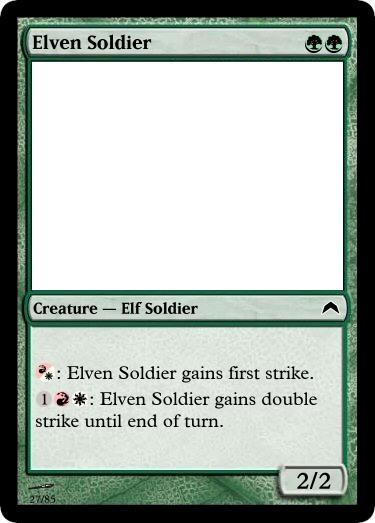
Crazy Idea: Elven Soldier

I'm not in the mood to do explaining today. I'll do it later. Elven Soldier.jpg

These are among what I call the cards people would've thought of, but definitely wouldn't ever see print due to templating or possible rules or remembering issues. After all, how many people could remember when you gave your Elven Soldier was given first strike when a lot of people don't even remember it's there when it's a static ability.

This is what I could call a partial echo ability. You could pay it and get a much cheaper creature over two turns, or live with a far more expensive and inferior creature for a while. You even get the opportunity to pay a higher cost for a temporary ability if you have the mana later. :D

There will be quite a few three-colour inclined spells later, although there will be no 3 colour spells. :D

Bored in Lectures

If I'm not wrong, learning usually means you're going to see and learn about new things. Learning about new things is loads of fun. I learned the basics of UNIX computing on my Mac last week after I found out I needed to compile some program from scratch so it would work. Before that, I learned from my friend that I would be using UNIX for Introduction to Programming, so I thought it wouldn't be too bad. What I later found out was that the UNIX server didn't really support my xterminal, which was described "xterm-color" (I'm sure all I have to do is change it, but I'm too lazy), which I'm sure is not very common. As a result, I'll probably be doing a lot of work at home, uploading and then testing it online before submitting it.

I went to Maths A to find my lecturer teaching what must have been elementary school maths to most of us in the class. For god's sake, we're in Maths A Advanced! Not Maths A Standard or Quantitative Methods! We had to get good results to even enrol in Maths A Advanced, not allow you to ramble on about things we already know!

Then, we have this subject called Scientific Programming and Simulation. It's fun because you learn something new here. A new language called R, which is supposedly a derivative of S-plus. It was pretty good, until you discover R is just a programmable calculator that runs on your computer and receives text input. Real fun, I might add.

I'm probably going to be bored for quite a while until projects and assignments come in, which is hopefully next week. I'm gonna stop here and go back to watching some obscure MPEG file. :D

Chapter 00 - 4: Prologue Part 4

Before the Arlt Alliance, Arltians did have a war known as the War of 23. This war was, as the name would suggest, the struggle of power by the 23 most powerful colonies. By the time the war ended, only 7 of the most resilient colonies survived within the borders of Arltian space. These 7 formed the Arltian Alliance, gathering less advanced colonies within it to stave intergalactic conflict. The two Terran corporations depended heavily on the Arlt Alliance for the education of the Gifted. Although there were only 28 of them in total, having the Gifted fully utilized was central to the accelerated development the Terrans had experienced. Before long after the 28 Gifted children were placed into key positions within the two corporations, the Terrans caught up with the most advanced colony within the Alliance.

Before long, a 29th Gifted came into view, and was the only Gifted Terran to receive education from other Gifted. This 29th person is now the Head of the First Division of Engineering within the TRi. It is believed that this 29th person already has understanding far beyond Arltian technology due to the unhindered learning from other Gifted instead of the Alliance.

As of now, there have been no other reported Gifted than the original 29. Terran territory has expanded greatly and efforts have begun on restoring the planet Earth. An individual body was formed with funds from GMTi and TRi to commence and execute all restoration processes to ensure neither corporation could lay claim to Earth.

The Terran Meganet eventually spanned far and wide, making Terran territory close to 25% the size of Alliance territory. It is believed that the Arlt Alliance has hyperspace technology independent of the travel gates, but has kept quiet on such technology, fearing that it might be used for conquest instead of exploration.

Darkness falls.